

What is Real Time Data Communication ?
Top 3 Real Time Data Communication Options for Modern Applications
What Is Real Time Data Communication?
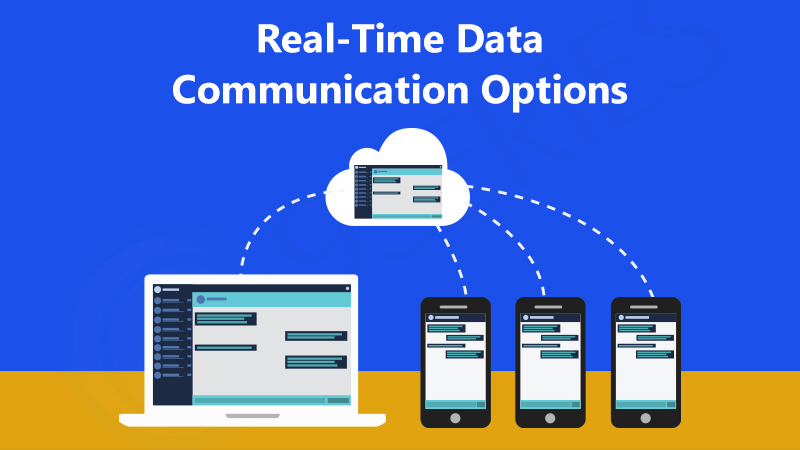
Real time data communication refers to the live streaming and instant exchange of data within software applications or mobile apps. Similar to a live event, data is received, processed, and returned within a specific time frame, often in milliseconds or microseconds.
For a system to qualify as real time, it must:
- Receive data instantly
- Process the data quickly
- Return results within a defined time limit
If the response is delayed beyond the acceptable time frame, it cannot be considered real time communication.
Examples of Real Time Applications
- Live streaming applications
- Stock market trading apps
- Chat and messaging applications
- Online gaming platforms
- Ride sharing apps
Today, many mobile app development companies build applications based on real time architecture to meet modern user expectations.
How Does Real Time Data Communication Work?
Real time applications typically follow a client server client architecture.
- The user interacts with the client application.
- The client sends a request to the server.
- The server processes the request and sends an immediate response.
- The client updates the interface instantly.
Real time communication is not just two way communication. It must also meet strict timing requirements. The response must be delivered within a specific time frame to maintain system integrity.
It is important to note that real time systems do not always require high performance computing. The key factor is timely response, not necessarily maximum processing power.
Top 3 Real Time Data Communication Options
Here are three popular third party real time communication solutions for Android and cross platform applications.
- PubNub
PubNub is a real time data streaming network and infrastructure as a service platform. It enables developers to build scalable real time applications with minimal effort.
Core Services
Publish Subscribe Messaging Pattern
- The sender is called a Publisher.
- The receiver is called a Subscriber.
- Publishers categorize messages into classes without knowing the subscribers.
- Subscribers receive messages based on interest categories without knowing the publisher.
This decoupled architecture improves scalability and flexibility.
PubNub Functions
Developers can run server side code directly on PubNub servers to process or transform messages between publishers and subscribers.
ChatEngine
ChatEngine allows quick implementation of chat features including:
- Private and group chat
- Emojis support
- Online and offline user status
- Message history
PubNub supports multiple platforms including JavaScript, Java, .NET, Objective C, and Swift.
- Firebase Realtime Database and CloudFirestore
Firebase, provided by Google, offers two major solutions for real time data management.
Firebase Realtime Database
- A low latency NoSQL database
- Stores data in JSON format
- Provides instant synchronization instead of traditional HTTP requests
- Sends updates to clients within milliseconds
- Supports offline mode by persisting data on disk
- Automatically syncs changes when the device reconnects
- Accessible from mobile devices and web browsers
- Supports authentication based security rules
Cloud Firestore
Cloud Firestore is a cloud hosted NoSQL database that stores data in documents similar to JSON.
Key features:
- Supports multiple data types including array, boolean, string, integer, map, and more
- Offline support for Android, iOS, and Web
- Advanced querying with chained filters
- Easier data filtering and sorting compared to Realtime Database
Cloud Firestore is ideal for complex applications requiring structured queries and scalability.
- AWS AppSync
AWS AppSync is a managed service from Amazon Web Services that enables real time data synchronization using GraphQL.
Key Features
GraphQL Integration
AppSync uses GraphQL, an open standard query language, allowing applications to request specific data efficiently from the cloud.
WebSocket Based Communication
AWS AppSync uses WebSockets for real time client server communication.
Data Security
It integrates with:
- Amazon Cognito
- AWS Identity and Access Management
This allows fine grained access control for GraphQL operations.
Conflict Resolution
AWS AppSync can automatically resolve data conflicts when multiple users update shared data simultaneously.
Considerations
- Works primarily when the application is open
- Developers must define message structures
- Requires GraphQL expertise
AWS AppSync is best suited for enterprise grade applications that require robust security and scalable cloud integration.
Conclusion
Real time data communication enables applications to process and deliver live data within a specific time frame. It is critical for chat apps, stock trading platforms, live streaming services, and many other modern digital products.
The top real time data communication options include:
- PubNub for scalable publish subscribe architecture
- Firebase Realtime Database and Cloud Firestore for mobile first applications
- AWS AppSync for GraphQL based enterprise solutions
Choosing the right solution depends on your application requirements, scalability needs, and security standards.
If you are planning to build a real time mobile or web application, selecting the right real time data communication technology is essential for performance, reliability, and user experience.
Stay tuned for more insights on modern software architecture and scalable application development.